2026 UGC Teaching Award honours excellent teachers
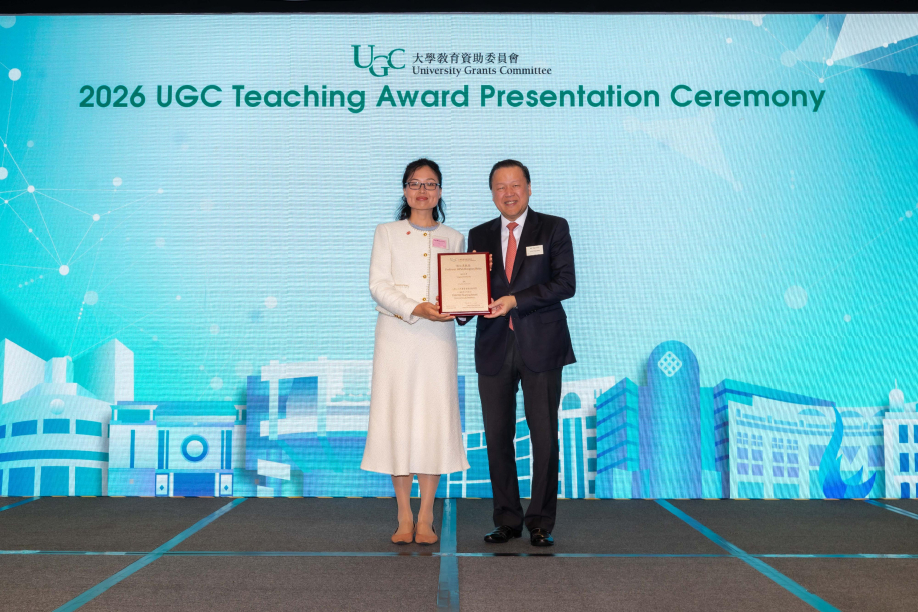
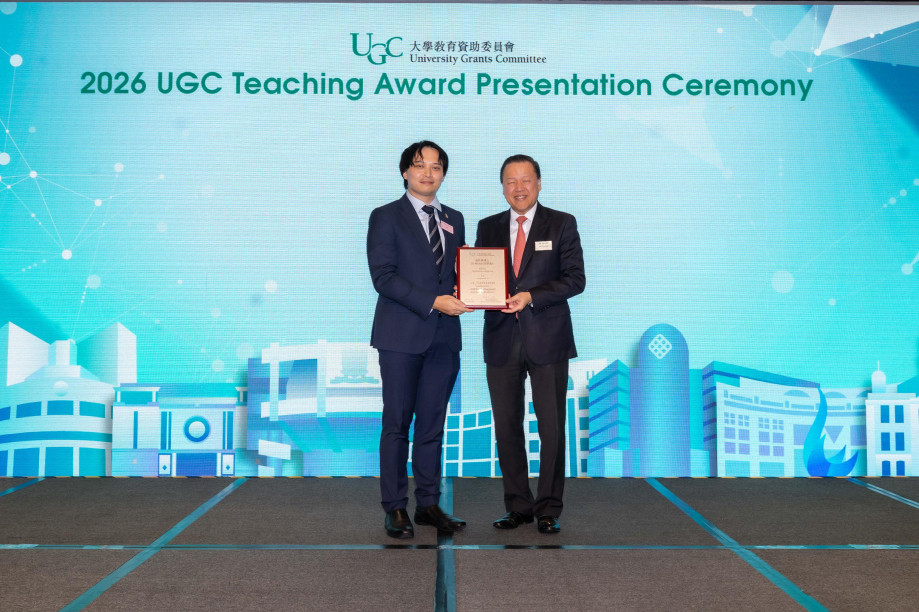
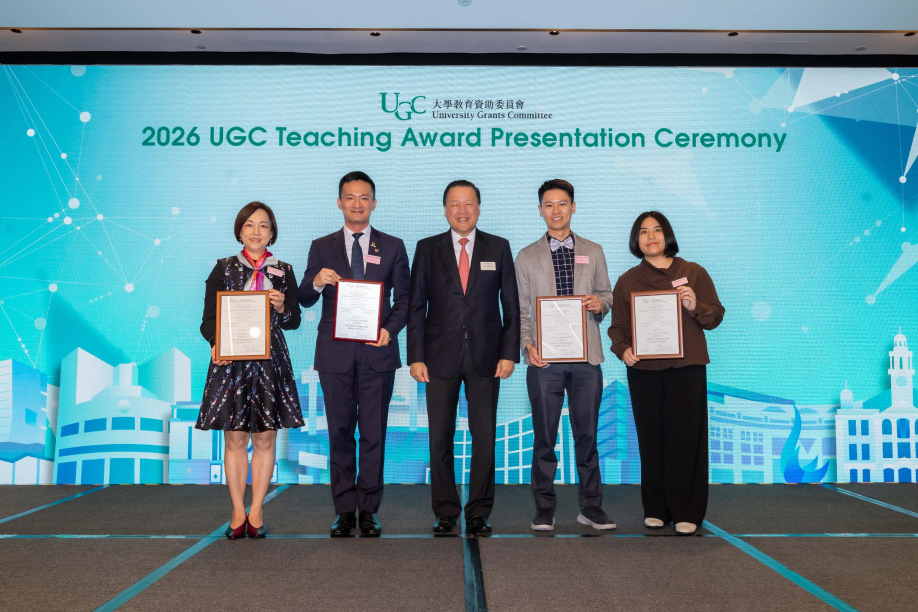
The University Grants Committee (UGC) held a presentation ceremony for the 2026 UGC Teaching Award today (September 29) to honour academics from UGC-funded universities for their outstanding teaching performances and achievements, as well as their leadership and scholarly contributions to teaching and learning within and outside their campuses.
Through a rigorous process, the Award Selection Panel selected the following three recipients from among over 20 outstanding nominees for the Award:
General Faculty Members
------------------------------------
Professor Helen Geng, Assistant Professor of Teaching, Division of Science, Lingnan University
Early Career Faculty Members
-------------------------------------------
Dr Michael Rivera, Lecturer, Faculty of Social Sciences, the University of Hong Kong
Collaborative Teams
---------
Eye Learn, I.CARE: Joint-University Eye Care Ambassador Training Scheme, led by Professor Kelvin Chong (Professor (Clinical), Department of Ophthalmology and Visual Sciences, Faculty of Medicine, the Chinese University of Hong Kong (CUHK)), with Professor Arthur Tsang (Associate Professor, Department of Curriculum and Instruction, Faculty of Education, CUHK), Dr Sharron Leung (Head of Nursing Education and Programme Director of Bachelor of Nursing (Hons), Hong Kong Baptist University) and Ms Stephany Tai (Research Assistant, Department of Ophthalmology and Visual Sciences, Faculty of Medicine, CUHK) as team members.
The citations of the awardees are in the Annex.
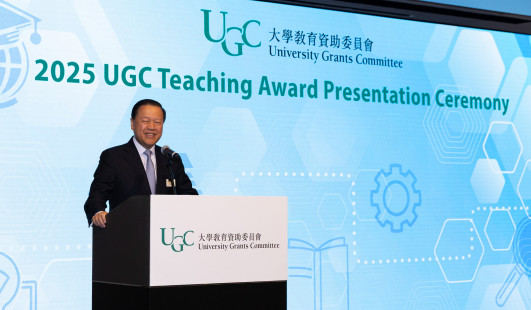
The Chairman of the UGC, Mr Tim Lui, congratulated the awardees, finalists, and nominees for their remarkable achievements and expressed gratitude to all UGC-funded universities for their support of the UGC Teaching Award. He said, "The UGC remains firmly committed to investing in quality teaching and learning, and encourages institutions to collaborate more closely and share effective practices, so that successful ideas can generate impact beyond individual projects or campuses. Through this collective effort, we can further enhance the quality of teaching and learning, broaden the reach of pedagogical innovation and reinforce Hong Kong's position as a leading international hub for higher education."
The Chair of the 2026 UGC Teaching Award Selection Panel, Chair of the Quality Assurance Council (QAC) and member of the UGC, Mr Dieter Yih, remarked, "The panel was deeply impressed by the awardees' outstanding pedagogical innovation, dedication, and impact. Professor Geng has made a meaningful contribution to sustainability and experiential education locally and beyond and empowered students to translate knowledge into purposeful action through her learner-centred teaching approach. Dr Rivera's care for students and passion for anthropology establish him as an outstanding early-career educator with remarkable impact. The Eye Learn, I.CARE Team enabled students to connect academic knowledge with authentic healthcare settings and exemplifies how tertiary education can generate tangible societal impact while nurturing lifelong learners committed to empathy, compassion, and social responsibility."
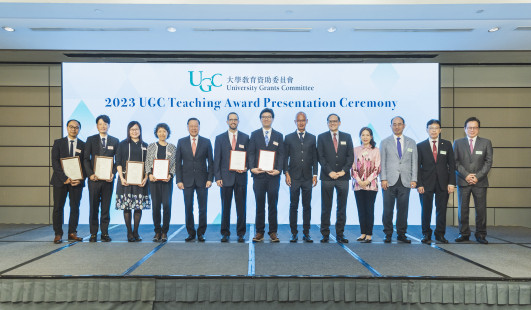
The presentation ceremony was attended by members of the UGC and the QAC, council chairmen and senior management of UGC-funded universities, as well as nominees for the Award.
The UGC has also produced a series of short video clips to promote best teaching practices by showcasing the teaching approach of the 2026 UGC Teaching Award recipients. The clips, together with the selection criteria and the composition of the Selection Panel, as well as the list of other finalists, are available on the UGC website www.ugc.edu.hk/eng/ugc/activity/ugc_teaching_award/result.html.
Annex
2026 UGC Teaching Award Citations
Professor Helen Hongyan Geng, Lingnan University
Professor Helen Hongyan Geng is a dedicated educator in sustainability science whose pedagogy is driven by a clear mission to cultivate proactive, self-directed graduates who are confident in translating knowledge into impactful action. Her teaching philosophy is embodied in her C.O.R.E. framework (Co-creation, Operationalisation, Realisation and Empowerment), a learner-centred approach that progressively engages students in shaping their learning journeys, applying academic knowledge within authentic contexts and developing into purpose-driven agents of change. Her distinct pedagogical strengths are defined by her expertise in Artificial Intelligence-integrated curriculum design, interdisciplinary inquiry, and systemic community engagement.
Professor Geng's innovative service-learning initiatives, including a textile waste project in partnership with NGOs and the Rujiang Project supporting left-behind children in Sichuan Province, have engaged 107 university mentors and benefited 1,213 children across 22 communities. These initiatives empower students to bridge theory with practice, cultivating core competencies in cross-cultural collaboration, empathy, and civic responsibility, while directly advancing the United Nations Sustainable Development Goals (SDGs), particularly SDG 4 (Quality Education), SDG 12 (Responsible Consumption and Production), and SDG 13 (Climate Action).
Through her C.O.R.E. framework, innovative curriculum design and commitment to bridging interdisciplinary learning with community practice, Professor Geng has made a meaningful contribution to sustainability and experiential education, empowering students to translate knowledge into purposeful action.
Dr. Michael Rivera, The University of Hong Kong
Dr Michael Rivera is an innovative and passionate educator who has established a remarkable profile in anthropology education. As the first person in Hong Kong to obtain a doctoral degree in biological anthropology, Dr Rivera has curated a distinctive teaching portfolio that spans archeology, sociocultural anthropology, human ecology, evolution, and critical race studies. His classes are characterised by a clear pedagogical commitment to active learning, experiential enquiry and reflective practice, creating engaging learning experiences that encourage students to think critically and independently.
Central to Dr Rivera's educational philosophy is the creation of both “brave spaces” and “safe spaces” for experimentation and confidence building. The “brave spaces” encourage students to think outside the box, while his care-based pedagogy places compassion and connection-building at the heart of the classroom. Through this approach, he helps students build resilience and develop critical thinking, preparing them for a fast-changing world.
Dr Rivera places particular emphasis on bridging classroom knowledge with the real world. He has developed a wide range of innovative assessments that encourage students to communicate what they have learnt to the wider public. As a result, his students not only deepen their understanding of course content, but also develop sophisticated communication skills. His passion for his academic field, together with his care and compassion for students, has established him as an outstanding earlycareer educator with remarkable potential and impact.
Eye Learn, I.CARE: Joint-University Eye Care Ambassador Training Scheme, led by The Chinese University of Hong Kong
The team led by Professor Kelvin KL Chong (The Chinese University of Hong Kong (CUHK)), with Professor Arthur Tsang (CUHK), Dr Sharron Leung (Hong Kong Baptist University) and Ms Stephany Tai (CUHK) as team members, spearheaded the Eye Learn, I.CARE (ELIC): Joint-University Eye Care Ambassador Training Scheme. Guided by the philosophy of “Volunteer to Learn, Learn to Volunteer”, ELIC combines interprofessional learning with community service, nurturing empathy, compassion and social responsibility while equipping students from UGC-funded universities, tertiary institutions and secondary schools as Eye Care Ambassadors.
Central to ELIC is its learner-centred “REST Framework” (Research, Education, Service, and Technology). Through research projects, flipped-classroom learning, specialised workshops, and supervised eye-care services, students connect academic knowledge with authentic healthcare setting. By bringing together learners from different backgrounds, the programme values complementary expertise and nurtures an integrated approach to addressing healthcare challenges. Partnerships with NGOs further enable students to organise outreach activities for marginalised communities, deepening their understanding of local health disparities while strengthening teamwork, communication and humanistic values.
Technology is also thoughtfully embedded in the programme through tools such as digital logbooks, an online human resources system with real-time dashboards, and an automated station roster, facilitating competency monitoring, professional conduct assessment and formative feedback. With strong potential for sustained dissemination across the UGC sector and beyond, ELIC exemplifies how tertiary education can generate tangible societal impact while nurturing lifelong learners.