
Prof. Hin Lap YIP
Department of Materials Science and Engineering
City University of Hong Kong
Biography
- Professor in Department of Materials Science and Engineering at City University of Hong Kong
- Research focuses on understanding photophysics and optimizing organic and hybrid perovskite devices
- SRFS project — aims to develop a new generation of solar cells with higher efficiency, stability, and adaptability. Specifically, the project is creating all-perovskite triple-junction tandem solar cells, which can achieve power conversion efficiencies above 33%. The outcome will be solar devices that are not only highly efficient but also thin, light, and versatile. They can be integrated into building façades and windows, applied in aerospace and marine environments, and used as portable energy sources. This innovation will support Hong Kong’s 2050 carbon neutrality target and contribute globally to advancing renewable energy technologies.
- Awards and Honours:
- RGC Senior Research Fellow (2025)
- Highly Cited Researchers (11 times from 2014-2024), by Clarivate
- Fellow of the Hong Kong Institute of Engineers (FHKIE, Materials discipline), 2024
- Fellow of the Royal Society of Chemistry (FRSC), 2023
- Hong Kong Engineering Science and Technology (HKEST) Award, 2023
Project Title
- Next-Generation Tandem Perovskite Solar Cells: High-Efficiency, Flexible, and Scalable Solutions for Diverse Applications
Award Citation
This project pioneers the development of high-efficiency all-perovskite triple-junction tandem solar cells (TSCs), with a target power conversion efficiency above 33%, significantly exceeding the 27% ceiling of conventional photovoltaic devices. Achieving this performance would represent a technological breakthrough, delivering more clean energy from the same sunlight and advancing the long-term affordability of solar power.
Perovskite materials are highly promising because of their lightweight nature, tunable bandgaps, and compatibility with low-cost solution processing. These features allow the design of tandem devices that capture a broader portion of the solar spectrum. However, technical obstacles remain: wide-bandgap perovskites are prone to phase segregation, narrow-bandgap counterparts are vulnerable to oxidation, and interconnection layers must simultaneously ensure efficient charge transport and environmental protection. In addition, reliable encapsulation strategies are essential for flexible and durable devices. The project integrates materials design, interface engineering, novel deposition approaches, and device modelling to address these challenges. By formulating stable perovskite compositions, enhancing passivation against degradation, and optimizing interconnection and encapsulation layers, the research will translate laboratory advances into scalable, real-world applications. The resulting TSCs will combine high efficiency, stability, and versatility. They may be integrated into building façades and windows, deployed in aerospace and marine systems, or used in lightweight portable devices.
This innovation not only supports Hong Kong’s 2050 carbon neutrality target but also contributes globally by offering dense urban environments a practical and sustainable solar-energy solution.
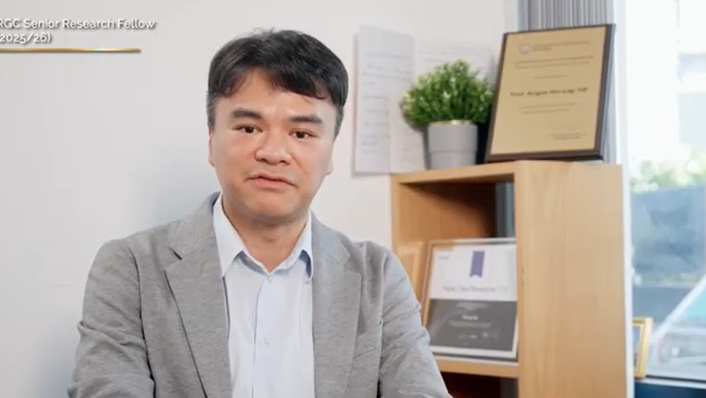
Short video of awardee